Super Volcanoes
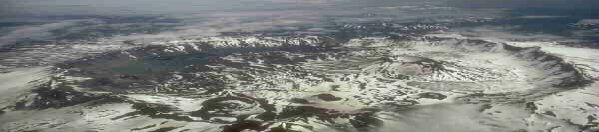
Aniakchak Caldera, Alaska
The subject of volcanoes is so vast that it is hard to know where to start. I had toyed with the idea of doing a page on volcanoes but not being an expert I didn't know by which end to start and I didn't really want to do "Another" page about Hawaiian Volcanoes or Pinatubo until...
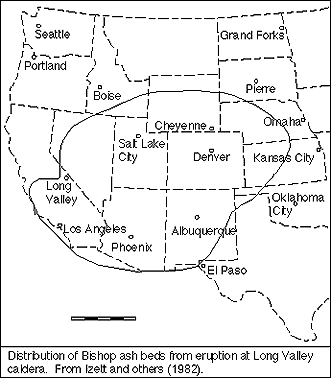
I was watching the TV one day and switching channels I came across a BBC documentary about super volcanoes. Having switched over after the start I missed the title and the theme of the documentary and was half watching and half toying with the idea of switching channels again when I actually started listening. The narrator was explaining how a palaeontologist, studying fossils in Antelope county, Nebraska, stumbled across what was probably one of the most astounding and intriguing sights a palaeontologist could ever expect to find. It was the sight of a sudden cataclysm. Hundreds of fossilised prehistoric animals enveloped in volcanic ash¹.This was intriguing because there are no volcanoes in Nebraska and it is a known fact that volcano eruptions, such as Mount St Helens, Washington state, considered a strong eruption, only spread ash as far as ± 30 miles.
(In fact, this has been known to happen at least twice before in prehistoric times. Once 11 million years ago when the 'Bruneau-Jarbridge' eruption occurred and once ±750 000 years ago when the cataclysmic Long Valley, California, volcanic eruption blew out 150 cubic miles of magma as far east as Nebraska)
By now I was beginning to follow the documentary with growing interest. After studying the immediate vicinity, the scientists were starting to look further afield and determined that the ash actually came from a volcanic eruption some 1000 miles to the west (NOAA map of the USA). If this was indeed the case the scientists were discovering the existence of a geological force of such dimensions it would relegate a lot of other geological or meteorological phenomena to a lesser degree of importance.
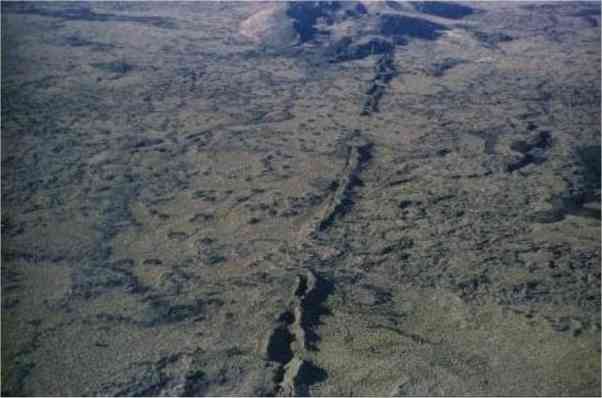
The geologists had backtracked the ash, from Nebraska, to the initial point of eruption. They had found a depression, or caldera¹, in the ground and estimated that the caldera was the result of a geological implosion, measuring, in the process, the caldera to be of ± 50 sq miles (± 130 km²) in size.
¹ Caldera: The Spanish word for cauldron, a basin-shaped volcanic depression; by definition, at least a mile in diameter. Such large depressions are typically formed by the subsidence of volcanoes. Crater Lake ² in Oregon occupies the best-known caldera in the Cascades.
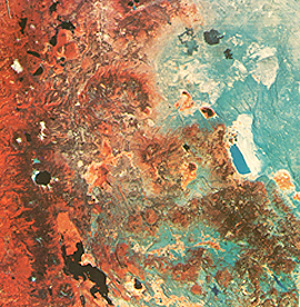
²The Crater lake Landsat scene in southern Oregon (just below the bottom of the mosaic) contains several features of special interest both within and east of the Cascades.The focal point in the Landsat image is the circular lake known as Crater Lake. This 12 km wide (8 miles) lake lies within a volcano, known as Mt. Mazama, that collapsed and erupted violently about 10000 years ago, probably before humans had settled in the region, expulsing thick ash beds ( much more than expelled from Mt. St. Helens in 1980).
Klamath Lake lies near the bottom of the image. The blue lake to the east is Summer Lake. The Great Sandy Desert (dark blue) is a series of volcanic flows that are roughly coeval with the Snake River Plains to the east.Striking also is the conspicuously large elliptical feature northeast of Crater Lake which resembles a huge volcanic caldera. The western part, known as the 'Walker Rim', is a cliff composed of volcanic flows, however, solid evidence for a caldera was not obvious. This may be the result of a concordance of several topographic features and because of vegetation distribution gives the impression of ellipticity.
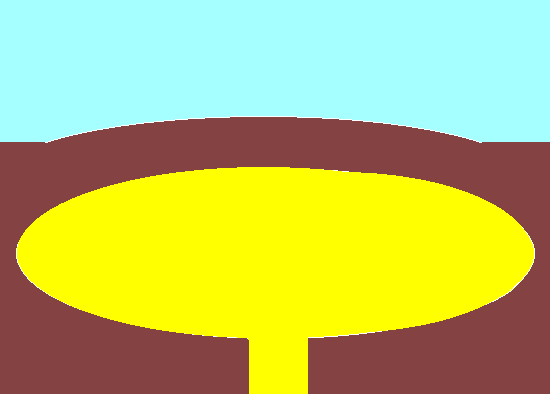
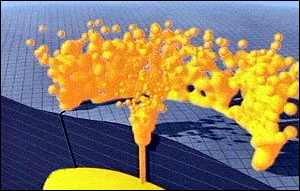
By sounding the ground under the caldera³, as well as in the vicinity, the geologists found traces of a subterranean chamber. Traces of vertical shafts in the earth's core were also found and it was deduced that these shafts had been formed by magma pushing up through faults in the earth's crust allowing the magma to flow into the subterranean chamber and gradually fill it until it had completely filled the chamber and could apparently fill the chamber no further. However the magma had apparently continued to pour into the chamber causing the ceiling of the chamber to bomb, or convex upwards. This continued until the pressure was so great that the roof of the chamber eventually exploded, propulsing lava and rock over such as distance as to reach Nebraska ± 1000 miles to the east.
¹ Volcanoes containing tephra sheets, such as the composite cones, are more prone to forming calderas once an eruption occurs.
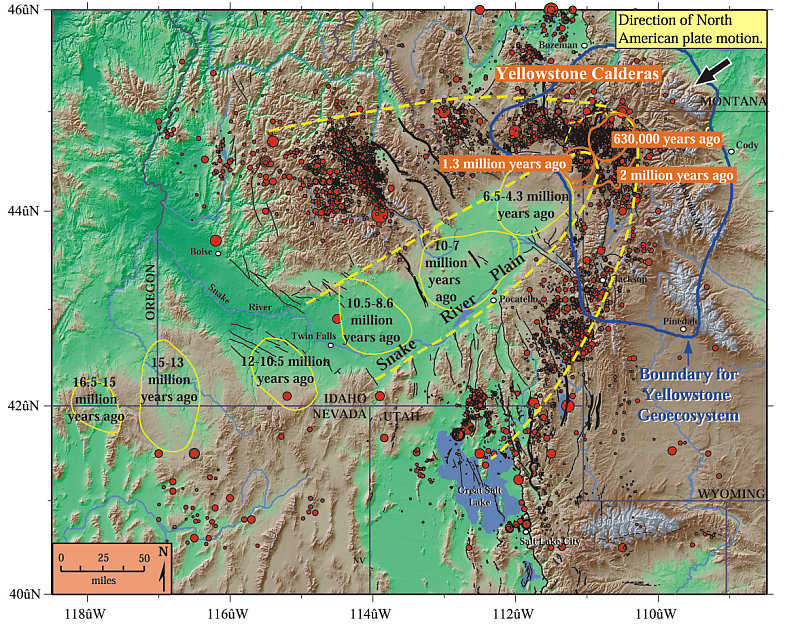
At this point in the documentary the narration switches back to Yellowstone explaining how one particular geologist has been monitoring the Yellowstone Park since the 60's and had noticed variations in the seismological readings. Tourist attraction that it is and being strategically placed towards the western rim of the North American Tectonic plate the Yellowstone National park is closely monitored and has been since the 1920s, and since that time the geologists have been seeing that the surface of the Yellowstone National park has been imperceptibly rising to such a point that by the mid 1980s a rise of a metre had been measured.
Yellowstone and the NASA
Apart from monitoring the seismological activity in the Yellowstone National Park, geologists have also been studying the actual layout of the park itself. This study of the Park took on a new dimension when they had the chance to collaborate with the NASA. The NASA were wanting to test a new camera for their next expedition to Mars and the camera was destined to study the Martian floor and what better way to test real-time and under relatively similar conditions than to combine their testings with the geological studies underway in the park. (NB. Since then the Park is under Satellite observation).
The scientists had known about the different geological periods of the Park and were looking for ways to develop their existing knowledge so when the chance to work with the NASA presented itself it was seized upon. Before the testing started the scientists had no idea just how beneficial this joint venture was going to be and what the long-term impact would be.
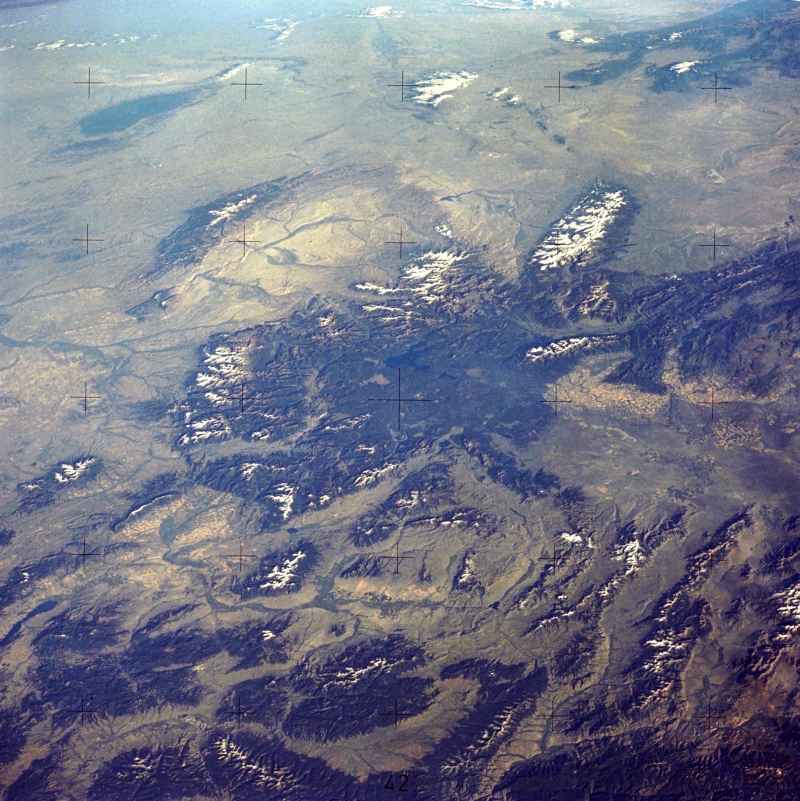
The testing started and the NASA's Turboprop flew long and large over the Park and took a series photographs. Once the photographs were developed the revelation was immediate. The photographs clearly illustrated not one caldera but 3 overlapping calderas.
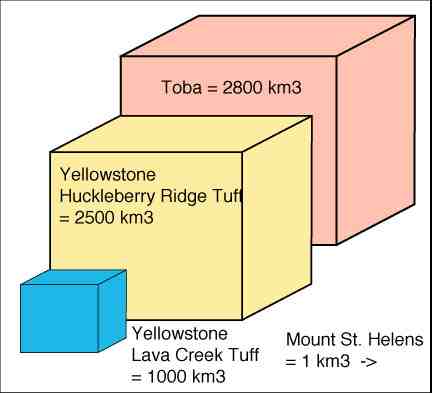
The scientists were astounded. They totally, but naturally, ignored the existence of any such caldera in the Park. Seen from ground, with all the trees, mountains, valleys , rivers, etc. it was impossible to spot any such calderas as they are totally hidden to the eye at ground level. However once alerted and with the help of the aerial photography the scientists set about studying the overlapping calderas. They were able to determine that each of the 3 calderas corresponded with a distinct period of volcanic activity and they were able to date each activity at intervals of ± 600 00 years. The 01st and oldest caldera being dated ±2 000 000 years ago (Huckleberry Ridge Tuff ¹), the 02nd at ±1 300 000 years and the 03rd ±630 000 years ago (Lava Creek Tuff), sweeping volcanic ash, pumice, and gases across an area of more than 3,000 sq miles..
(¹Tuff: Rock formed of pyroclastic material.This left the scientists with a dilemma. If the 3 eruptions had occurred at intervals of ±600 000 years and the last one was ± 600 000 years ago then it could be reasonably supposed that another eruption in the Yellowstone National Park was imminent, if not overdue. The thought was frightening. Should a Super Volcano erupt today the result would be a continental cataclysm
The 'Crater lake' and 'Long valley' super-volcanoes had exploded in prehistoric times (± 11 million years and 750 000 years ago). The planet was different then and above all, it was void of human life. When it is considered that ash from the 'Crater lake' eruption was found ± 1000 miles from the point of eruption should the Yellowstone park erupt, in Wyoming, today lava and rock would be sent as far as Los Angeles and San Francisco with such devastating effect that not even the 1906 San Francisco earthquake combined with the Mt St Helens eruption could compare with the after effects of a super volcanic eruption.

The "Yellowstone Park" Super Volcano - Today
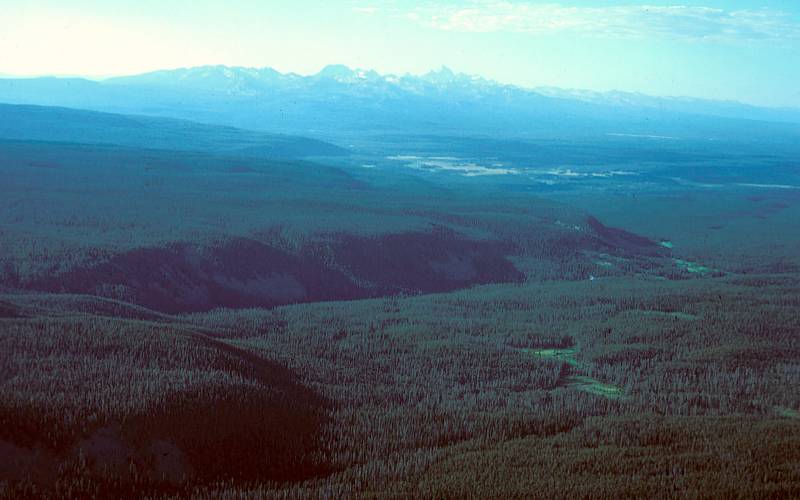
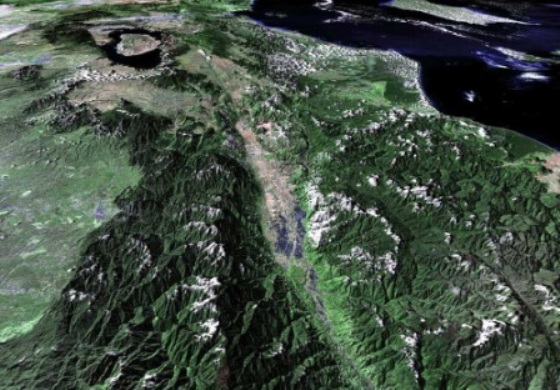
click to see full size*
*Aerial view toward the south of thick intra-caldera lava flows of the forested Madison and Pitchstone Plateaus, burying the west rim of the Yellowstone caldera. The plateaus preserve the characteristic form of these thick flows, The Teton Range rises beyond the caldera to the distant skyline.
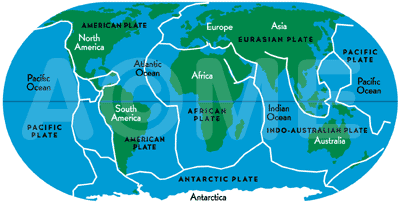
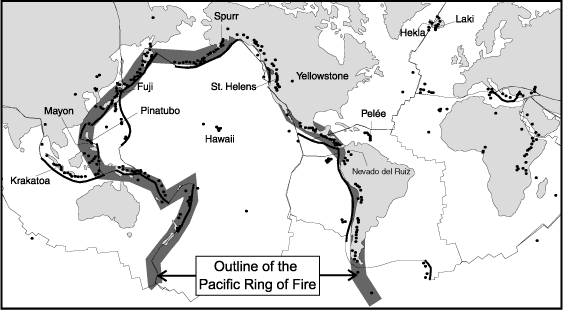
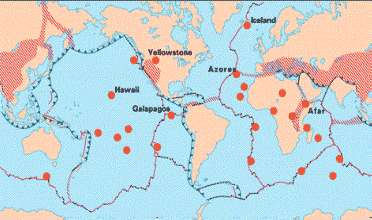
Although the planet is covered, from Iceland to New Zealand, and all around the Pacific ring of fire, with numerous volcanoes punctuating the planet's tectonic plates, there are, however, only an estimated 50 "Hotspots" that could be classified as "Super Volcanoes" and the Yellowstone National is one of them.
NB. The term "Super volcano" is recent and apparently can be attributed to the BBC's Horizon team
It is fairly logical to think that a certain number of the other super volcanoes are submarine as it safe to say that there are others, possibly active on the surface of the earth that are still to be identified,
Alaskan Earthquakes Affect Yellowstone
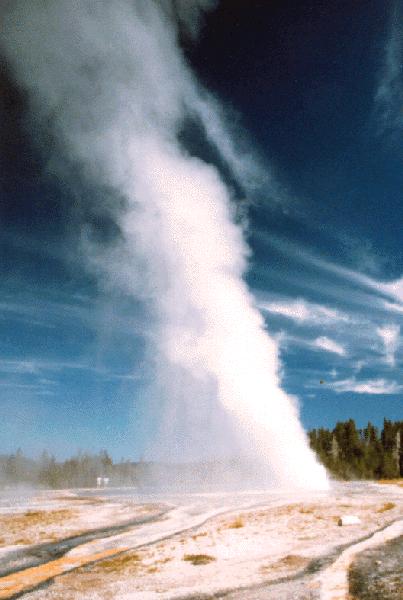
A brief excursion to Alaska illustrates the interactivity of tectonic plates, in this case, the North American plate. According to reports in 2002, a major earthquake in Alaska, one of the strongest in North America in the past 150 years, set off a chain of smaller earthquakes in the Yellowstone National Park more than 2,000 miles away and within hours, according to one report published by the journal "Geology", the geysers in the park changed their eruption patterns. Researchers believe that earthquakes keep geysers alive by periodically shaking loose clogged channels.
A Thousand Smaller Quakes
.Robert Smith of the University of Utah says that this study shows that large earthquakes at large distances can have profound effects on the Yellowstone geysers and that they had not expected to see these prolonged changes in the hydrothermal system. The geysers showed changes just a few hours after the shock waves, from the November 3 Alaskan earthquake, passed through the region triggering more than a thousand minor local earthquakes with the shock waves, many of them near hot springs and geysers, altering water and steam pressure in the geysers, opening new channels and unclogging others.
In the study, the researchers looked at the eruption patterns of 22 geysers during the winter of 2002-3 noticing that eight geysers showed major changes. One of them - Daisy Geyser - erupted more often but returned to its normal pattern after a few weeks. The geysers Castle, Plate and Plume also displayed short-term irregularities that lasted for a few days. Several small hot springs, not known to have geysered before, suddenly surged into a heavy boil with eruptions as high as one metre. The temperature at one of these springs increased from about 42C to 93C in a very short period of time and became much more acidic than normal. In the same area, another hot spring, usually crystal clear, turned muddy.
NB. Scientists once believed that an earthquake in one location could not trigger earthquakes at distant sites. That view was altered after the 1992 Landers Earthquake (magnitude 7.3) in California's Mojave Desert triggered a spate of quakes more than 800 miles away at Yellowstone.
Researchers believe that the Alaskan quake focused its energy south-east towards Yellowstone meaning that the stresses rippling through the ground at Yellowstone were 200-300 times greater than if the earthquake's waves were aimed elsewhere. So when you think that a super volcano eruption is due anytime now in the Yellowstone park it makes one wonder just what exactly would it take to trigger an eruption there?
NB. Information supplied courtesy of the BBC
Toba Caldera, Sumatra - Yesterday
One super volcano that has, however, been identified, is Lake Toba in Sumatra. The 'Lake Toba' Super volcano exploded ± 75 000 years ago covering the entire planet with volcanic clouds. The result was radical for the planet. The clouds were loaded with mineral that deflected the sunlight and caused the temperature of the planet to drop globally by ±5 degrees F and at certain latitudes, by ± 15 degrees F (Some estimates put the average world wide drop in temperature to be about 21 degrees). An estimated 75 percent of the northern hemisphere's plants are thought to have died. Six years of this dramatic cooling triggered a thousand-year ice age causing a volcanic winter but most importantly it all but eradicated the human race, such as it was at the time, from the face of the planet.
Following various studies (see below) scientists have estimated that following the 'Lake Toba' Super volcano eruption the number of our ancestors dropped to as low as ±5 to 10 thousand... in the whole world!
To corroborate this hypothesis geneticists, studying the Human DNA, had realised that there is, in fact, very little variation in the DNA of the 6 billion humans alive today and remarking this lack of variety the geneticists undertook to elucidate this phenomenon. Due to the fact the geneticists can study DNA mutation, allowing them to chronicle all the major events of our past, they were able to establish the fact that the human race had experienced a catastrophic reduction in the size of its population at a given point in its past. It appears that a genetic 'Bottleneck' had occurred highlighting not only a radical reduction in the human population but also that our collective DNA had diminished in variety for some unknown reason.The reason was not long in finding. A geologist visiting a university in the north-central USA was attending a genetics seminar given by a geneticist. At the end of the seminar, the geologist was talking to the geneticist and mentioned super Volcanoes. The geologist explained about the Lake Toba super volcano eruption some 75 000 years ago and the scientists were able to make the connection between the Lake Toba Super volcano eruption and the cataclysmic reduction in variety of the human DNA, estimated to have occurred some ± 70 000 ago as well! And so it was established that the Lake Toba Super volcano eruption was responsible for the volcanic winter that lasted an estimated 1000 thousand years afterwards, and which lead to the near extinction of the entire human race and the modification of the human DNA today.
click to enlarge
The Lake Toba caldera is 18 x 60 miles (30 by 100 km) and has a total relief of 5,100 feet (1700 m). The caldera probably formed in stages. Large eruptions occurred 840,000, ±700,000, and 75,000 years ago.
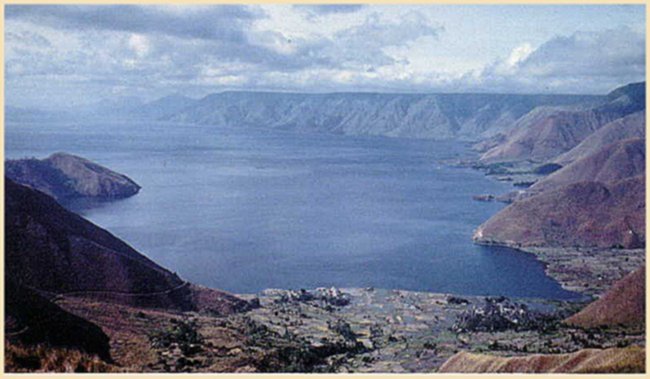

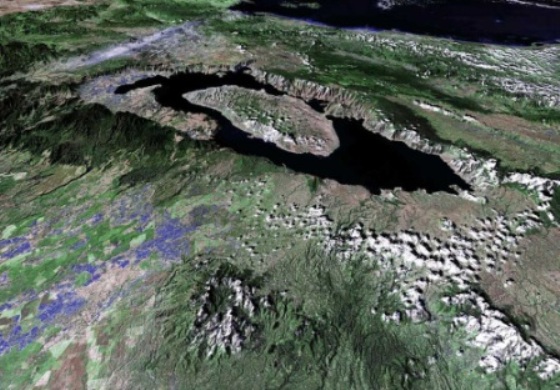
The eruption, 75,000 years ago, produced the Young Toba Tuff. The Young Toba Tuff erupted from ring fractures that surround most or all of the present-day lake. There have been no eruptions at Toba in historical time.
Conclusion - The Future
The Yellowstone super volcano is under close watch but what if the eruption come from another, as yet unknown, super-volcano? What would the impact be? What if the eruption came from a submarine super-volcano? The sizes of the resulting Tsunamis would be such that whole, densely populated (not to say overpopulated) regions of our planet (Bangla Desh , Hong Kong, Japan, California, Europe...) would be submerged.
The Lake Toba eruption produced the largest eruption in the last 2 million years and even with this knowledge combined with data from the other known super-volcanoes, the scientists have no way of preparing for them, they have no precedence, no factual, historical data to work from only projections and theories.
While it is true that scientists have no idea exactly what the impact of such an eruption would be, it does not need much to imagine the after effect of such a cataclysm on humanity today. If the Yellowstone super volcano explodes¹, or any other on this planet for that matter, not only would virtually the whole of the USA be devastated but the entire planet would be immersed in a volcanic winter lasting perhaps another 1000 years, virtually if not totally annihilating modern day technology, communications and trade. The fact that there are six billion people alive today, much more than 75 000 years ago, the consequences of such a cataclysm would be so radical the human race, reshaping geographical and political boundaries,wasting global agriculture and ruining whole economies, it would return mankind to the stone age.(¹ Scientists are all apparently unanimous in saying that it is not a case of 'if' a super volcano explodes but 'when'.)
A Final Word
The documentary conlcuded on this rather pessimistic note leaving the viewer to reflect on mankind's place in the future. It rather relegated everyday worries to a secondary role. However the human being is a resilient creature and because life must carry on, there's no doubt that scientists are working on preventive measures to avoid a massive explosion of the Yellowstone super volcano, such as Geothermal technology. Not only would this help reduce sub-surface tension in or around the various magma chambers, it would also create another source of renewable energy to replace a) rapidly dwindling carbon fossil sources of energy and b) the highly volatile nuclear energy until man can come up with a cleaner, more stable and environmentally friendly alternative.
Acknowledgments
A very special thanks to the NASA, the NOAA, the Yellowstone National Park for the technical data as well as, of course, the BBC. After having watched what was a very intriguing and interesting documentary I wanted to do some researching of my own to better understand the phenomenon of super volcanoes. In creating this page I have tried to avoid copying texts "ad verbatim" but, while respecting Intellectual Property, describe the problematic as I understand it with the help of the information available to the general public.


© Nicholas Richards 2004